
You're Not Overtaxed. You're Understructured.

Last month, I sat across from a surgeon (an orthopedic practice owner making just north of $800K) who said something I hear almost every week.
"Jared, I'm getting killed on taxes. I need a better accountant."
I paused. Took a sip of coffee. And then I told him what I'm about to tell you.
Your accountant probably isn't the problem.
The Real Diagnosis
When a surgeon tells me they're overtaxed, I don't reach for the tax code. I reach for their entity structure. Because nine times out of ten, the tax bill they're frustrated about is really a structure problem disguised as a tax problem.
Think about it this way. You wouldn't diagnose a patient based on their chief complaint alone. You'd order imaging. You'd look at the whole picture. The same applies here.
When I look at a surgeon's financial structure, I'm scanning for three specific gaps—three structural leaks that, in my experience, account for most of the wealth erosion I see in orthopedic practices.
Leak #1: A Misaligned S-Corp Salary
If you're running your practice through an S-Corp (and many of you are), there's a number buried in your payroll setup that has an outsized impact on how much you keep: your reasonable compensation.
Most CPAs set this number once (when the S-Corp was formed) and rarely revisit it. But here's the thing: the "right" salary isn't static. It interacts with your retirement plan contributions, your QBI deduction, and your payroll tax exposure. Get it wrong in either direction, and you're leaving real money on the table.
For example, a surgeon earning $800K with a mis-set salary—say, $400K when it should be closer to $350K or strategically higher depending on your retirement plan design—can easily see tens of thousands of dollars per year in additional payroll taxes or lost retirement contribution capacity. In this scenario, that might be roughly $25K per year, depending on your specific facts and circumstances.
To put that in perspective: $25K a year compounds into a vacation home over time.
Leak #2: An Underfunded (or Nonexistent) Cash Balance Plan
This one makes my heart hurt every time I see it.
A cash balance plan is the single most powerful tax-deferral tool available to high-income practice owners. Depending on your age, compensation, and the specific actuarial design of your plan, you may be able to contribute roughly $150K–$350K or more per year on top of 401(k) contributions—in some cases even higher for older owners.
In 2026, the 401(k) limit is $24,500 ($32,500 with catch-up if you're 50 or older). That's helpful, but at $800K in income, it barely dents your tax exposure. A cash balance plan changes the math completely.
And yet, many orthopedic surgeons over 50 don't have one. Their CPA hasn't mentioned it. Their investment advisor doesn't specialize in it. So the single highest-leverage tool in the wealth-building kit sits unused, year after year.
At surgeon-level income, it's common to see missed tax-deferred contribution opportunities in the tens of thousands of dollars per year—often $45K–$80K or more—when a cash balance plan is absent. Every single year.
Leak #3: A Missing Cost Segregation Study
If you own your practice building (or any investment real estate) and you haven't done a cost segregation study, you're almost certainly overpaying your taxes.
Cost segregation reclassifies building components into shorter depreciation categories, accelerating your deductions. With the One Big Beautiful Bill Act restoring 100% bonus depreciation on most qualifying property acquired and placed in service after January 19, 2025, the impact of a cost segregation study can be even larger than it was under the prior phase-out rules.
For a typical surgeon-owned medical office building, a cost segregation study can often unlock tens of thousands of dollars of additional depreciation deductions—sometimes $15K–$30K or more in early years, depending on the building and improvements. That's money you're already entitled to. It's just sitting there, unclaimed, because nobody ran the study.
The Total: $80K–$130K+ Left on the Table
Let's add it up for our $800K-earning surgeon example:
S-Corp salary misalignment: ~$25K/year
Missing cash balance plan: ~$45K–$80K/year
No cost segregation study: ~$15K–$30K/year
Total annual leakage in this scenario: roughly $85K–$130K+ per year
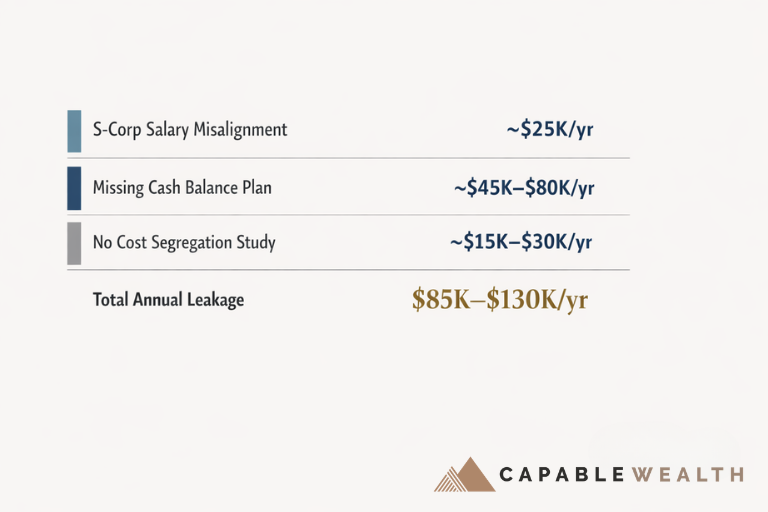
The source of that leakage is structural, and no amount of deduction-chasing will fix it.
Over a decade, consistently leaking tens of thousands per year can easily translate into seven-figure differences in net worth once you factor in missed compounding—in some cases, well over a million dollars in wealth that simply didn't need to be lost.
Structure Is Control
Here's what I keep coming back to. The surgeon I sat with that morning? He didn't need a new accountant. He needed someone to look at the whole architecture of how his income flows from practice to personal wealth, and to diagnose where the leaks were.
When I talk about financial freedom, what I really mean is control. Control over your time. Control over your choices. Control over the trajectory of your life beyond the OR.
And control starts with structure. Not a better tax trick. Not a hotter investment tip. Structure.
The same precision you bring to the operating room—the attention to anatomy, the awareness of what's connected to what, the refusal to skip steps—is exactly what your financial life deserves. And when you apply that kind of rigor to how your income is structured, the results can be transformative.
If you've never had someone take a hard look at your entity structure, your retirement plan design, and your real estate depreciation strategy, all together, as a coordinated system, this is the quarter to do it. Q1 data is coming in, April 15 is ahead, and the decisions you make in the next six weeks will shape your tax picture for the rest of the year.
The question isn't whether you're paying too much in taxes. It's whether your structure is built to keep what you earn.
Capably Yours,
Jared
Important Disclaimer
This post is intended for educational purposes and is directed toward U.S. orthopedic practice owners. The examples and figures provided are for illustration only and are not predictions, guarantees, or personalized advice. Tax outcomes depend on your specific facts and circumstances and on current law, which is subject to change. Nothing in this post constitutes tax, legal, or investment advice for any individual. You should consult your own CPA, ERISA attorney, or other qualified advisors before implementing any of the strategies discussed.